Concept & Objectives
Concept
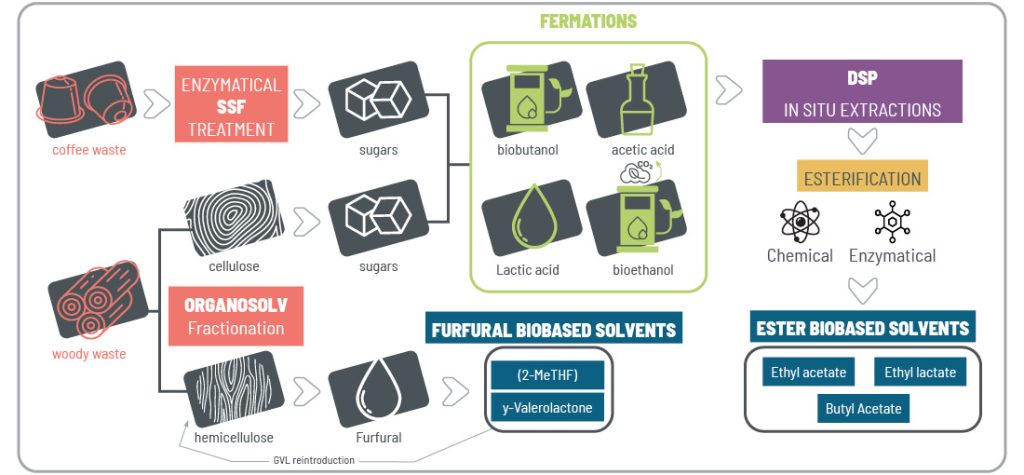
SOLRESS project will address the valorisation of two kinds of biomass feedstocks (lignocellulosic and spent coffee grounds) to obtain a sustainable and bio-based source to produce some of the most widely used solvents in the industry. The challenges will lie in improving downstream purification (DSP) processes and the techniques employed to achieve a technology that is efficient and cost-competitive with current chemical production systems for solvents.
Two ranges of Safe and Sustainable by Design (SSbD) bio-based solvents will be produced: the first pathway will focus on obtaining bio-based ester solvents, including ethyl acetate, ethyl lactate, and butyl acetate. Simpler solvents such as bioethanol and biobutanol can also be directly obtained through this route and validated in different sectors. The second pathway will focus on obtaining bio-based solvents derived from furfural by valorising the hemicellulose fraction of biomass feedstock, including γ-Valerolactone (GVL) and 2-Methyltetrahydrofuran (2-MeTHF).

Objectives
This ambitious goal will be achieved through the following five key objectives:
1
Develop effective pretreatment processes for coffee grounds and white birch chips to recover pure sugar streams for fermentation processes.
2
Optimize bioprocesses to convert CO2 and hydrolysates into organic acids (lactic and acetic acid), improving sustainability and efficiency by integrating electrochemical methods for acetic and lactic acid extraction.
3
Scale up bioethanol and biobutanol production from lignocellulosic feedstocks for bio-solvent synthesis including CO2 capture technologies.
4
Demonstrate esterification reactions and assess their effectiveness to produce ester bio-based solvents from organic acids and alcohols.
5
Scale up furfural production from hemicellulose to produce other bio-based solvents and valuable by-products.