Why Safe and Sustainable Solvents Matter Solvents are essential to modern chemistry?
Solvents are widely used in chemical reactions, extraction, separation and purification processes across both industry and research. Today, they are present in countless applications, from paints and coatings to cosmetics, pharmaceuticals, cleaning products and recycling technologies.
Yet despite their importance, conventional solvents often come with significant challenges. Many are derived from fossil resources, can present risks for human health and safety, and contribute to environmental impacts throughout their life cycle. As industries seek to reduce their environmental footprint and transition away from fossil-based feedstocks, the demand for safer and more sustainable alternatives continues to grow.
This transition is closely linked to the principles of Green Chemistry and to European initiatives such as the European Green Deal and the Safe and Sustainable by Design (SSbD) framework.
Putting Safe and Sustainable by design into practice The SSbD framework promotes the development of chemicals, materials and processes that are both safe for people and the environment, while remaining technically and economically viable. Rather than addressing environmental or safety concerns at the end of a product’s development, SSbD integrates these considerations from the very beginning of the innovation process.
At SOLRESS, SSbD lies at the heart of the project. The project aims to develop bio-based solvent alternatives that combine:
- High performance for industrial applications;
- Reduced toxicity and improved safety profiles;
- Lower environmental impacts;
- Renewable and waste-based feedstocks;
- Circular and resource-efficient production processes.
By combining these objectives, SOLRESS seeks to demonstrate that sustainability does not have to come at the expense for performance.
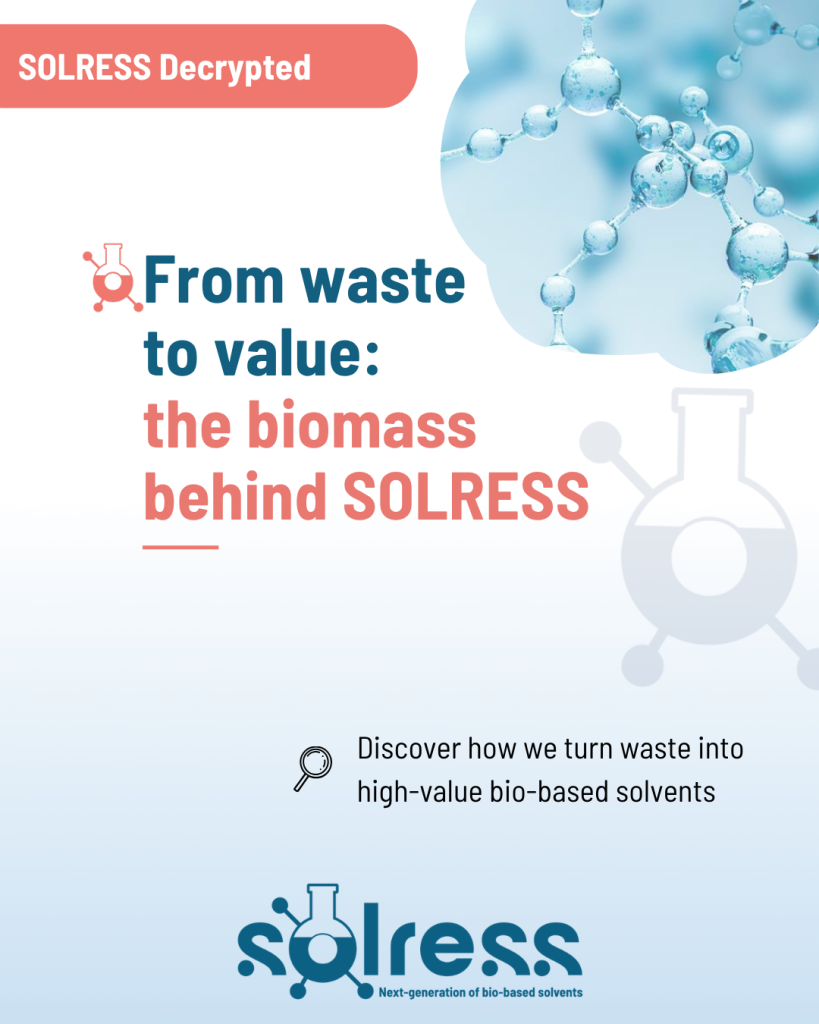
From waste to value: the biomass behind SOLRESS
One of the key challenges in developing sustainable solvents is choosing the right raw materials. Many bio-based chemicals currently rely on first generation biomass, such as sugars or crops that may compete with food production. SOLRESS instead focuses on second-generation and waste-based biomass resources. These resources can originate from:
- Agricultural residues and biowaste
- Forestry and wood-processing by products
- Industrial side streams and residues
By relying on waste-based and second-generation biomass, SOLRESS reduces competition with food resources while promoting waste valorisation, resource efficiency and circularity.
Among the biomass resources explored within SOLRESS, two stand out: spent coffee grounds and lignocellulosic biomass .
Coffee waste : an untapped resource
Coffee is one of the most traded commodities in the world. As global consumption continues to rise, so does the generation of coffee waste. Every year, approximately 6 million tons of spent coffee grounds are produced worldwilde, with around 3,3 million tons generated in Europe alone. Most of this material is currently disposed of through landfill or incineration2. However, spent coffee grounds contain valuable compounds including oils, antioxidants and polysaccharides, making them a promising feedstock for biotechnological application.
The project’s processes are expected to enable the valorisation of one tonne of spent coffee grounds into:
- At least 100 litres of each ester-based solvent developed within SOLRESS
- Approximately 50 litres of furfural-derived solvents
Unlocking the potential of lignocellulosic biomass
SOLRESS also explores lignocellulosic biomass, one of the most abundant renewable resources available. Lignocellulosic biomass is primarily composed of:
- Cellulose
- Hemicellulose
- Lignin
A major source of this biomass comes from woody residues generated by forestry and wood-processing activities. Although these materials are often used solely for energy recovery, they contain valuable building blocks that can be converted into chemicals and solvent with significantly higher added value.
Towards a Circular future for Solvents
SOLRESS demonstrates that the transition towards safer and more sustainable chemicals starts long before a solvent reaches the market.
By rethinking both feedstocks and production pathways, the project explores how waste and underutilised biomass can become valuable resources for the chemical industry, contributing to the development of next-generation solvents designed with safety, sustainability and industrial relevance in mind.